
“Medical Illustrators draw what can’t be seen, watch what’s never been done, and tell thousands about it without saying a word”
– Bill Gramley, Neal Pointer, Bill Winn, 1978
Since the beginning of human thought, visual images have been used to communicate our stories and ideas. With the rapid growth of the biological sciences and human medicine in today’s society, there is a greater need for enhanced scientific communication and public outreach. The medical/biological illustrator combines scientific knowledge with artistic skill to create such didactic visualizations. An illustrator can teach complex medical and scientific stories to a variety of audiences, bridging the gap between the general public and scientific professionals. Beyond simply creating aesthetically pleasing visuals, the medical illustrator conducts in-depth research and collaborates with scientists, surgeons, and other specialists in order to help bring about the understanding of complex subject matter with clear, concise and profound images.
What exactly do medical illustrators do?
The field of medical illustration has changed greatly over the years with the exponential rise of technology. In today’s world, medical illustrators create not only traditional illustrations for books, journals and magazines, but they also construct 3-D models, complex animations, and interactive teaching modules. Medical illustrators help to visualize the natural world around us, and within us, bringing to light the unseen, such as molecular processes that could not be visualized with even the most advanced imaging. Complex surgical procedures, or intricate physiological processes all need clear visuals to elucidate the relevant anatomy, physiology and proper technique. This cannot be shown with photographs or raw video alone. The medical illustrator provides new vantage points, removes extraneous information, and allows the viewer to clearly discern and assimilate the intended message.
Why not just take a photograph, or use imaging?

In today’s world, many people assume that photography can capture the entirety of the world around us with incredible accuracy. Even CT and MRI data can now be used to create 3D images of the world within us. However, what photography and imaging lack are the ability to edit, clarify and show structures or processes that cannot be seen either with the naked eye, or from a certain vantage point. The medical illustrator is able to bring obscure concepts to light using illustrations, animations interactive technology and more.
Medical illustration also plays a major role in the care of patients and their families. Patients deserve to be educated about their procedures without the use of gruesome or bloody images. Patient education illustration teaches the patients the appropriate information presented in a non-frightening manner.
The Process
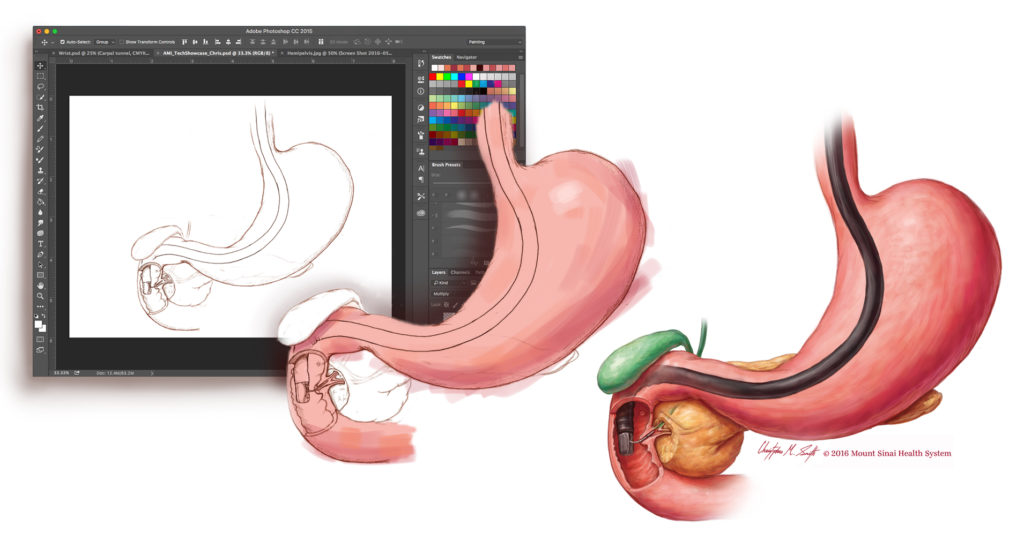
While all illustrators have a unique approach, the process of medical illustration usually begins with relevant background research including literature review of scientific papers, conversing with experts, hands-on dissection and for those lucky enough, direct surgical observation. From there, the next step is sketching or storyboarding, depending on whether the project is an illustration, 3-D model, animation or interactive module. This preliminary art helps to direct the focus of the creative process to generate the most effective, didactic visual design. During this process, revisions are key to getting the final piece of work as accurate as possible. In some cases, focus groups help to give extra feedback from the appropriate audience. The final product is reflective of the individual illustrator’s style, yet maintains the intended medical or scientific story with an emphasis on accuracy.
The role of a medical illustrator is more vital now than ever. Without them, rapid scientific advancement and the public’s understanding of it would deteriorate without the ability to effectively and clearly communicate new ideas and discoveries.
Links for More Information
Association of Medical Illustrators
Johns Hopkins University School of Medicine, Department of Art as Applied to Medicine
Guild of Natural Science Illustrators